‘the Savage Skulls Were the Most Dangerous Gang in the Bronx’: Jean-Pierre Laffont’s Best Photograph
The late 1960s and most of the 1970s were a difficult time for New York. I’d moved there from France in 1965 with a reporter friend and a plan to start a little agency, but soon found myself working alone. It could be a dangerous city, especially at night, but I enjoyed taking pictures of everyday life around me. In 1969, I became the first foreign correspondent for the Paris-based Gamma Agency, but always insisted on working on personal projects rather than assignments.
Reading the New York Times in 1972, I would see stories about gangs in the Bronx that were killing drug-pushers who targeted young people in the area. The police would find their bodies on the kerb at the bottom of five-storey buildings they’d been thrown off. The gangs included the Savage Nomads and the Dirty Dozen, but the one I was most interested in was the most dangerous: the Savage Skulls.
I didn’t want to go looking for them alone, so I drove with a French cameraman friend to Fox Street in the Hunts Point neighbourhood. As soon as we spotted members of the gang on the sidewalk, we stopped and wound down the window and they immediately came over wanting to know who we were. When they realised we were French and didn’t want to interview them, they said: “If you want just to look at our life, you’re welcome.” We spent that afternoon with them, then I came back alone the following day.
double quotation mark
I didn’t meet their chief because he was in hospital having taken a bullet to the abdomen
The gang showed me their territory: the basement where they had their club, played music and kept a lot of their weapons, and the sidewalks where Savage Skulls tags appeared on walls, doors and trash cans. They also spent a lot of time on a nearby basketball court. They didn’t actually play basketball – they just fought all the time, play-fighting, like little cats.
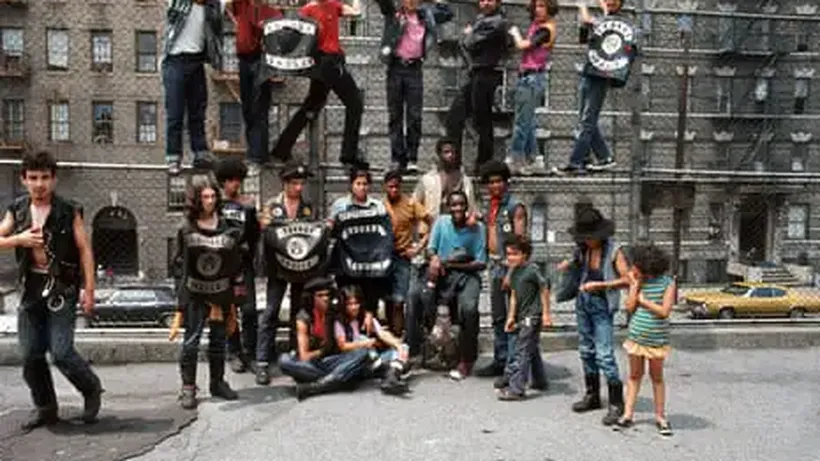
While on the court with them, I said: “OK, I’ll take a picture of you.” They immediately went over to the fence and got into the formation you see in the picture. I didn’t ask them to do that: it was completely spontaneous. They were keen to show off the sleeveless denim vests they wore, with a skull and crossbones painted on the back. You can see here how young they were. I think the youngest member I photographed was 13 and none of them were much older than 20. The photograph reminds me of a scene from West Side Story, but I don’t think members of the Savage Skulls ever left the Bronx.
When I told the police about my project, they warned me they couldn’t offer any protection, but while I was with the gang one time they stopped a patrol car and I took a picture of them having a friendly chat with the officers inside. The members were mostly Puerto Rican and spoke Spanish to one another, so we communicated in broken English. I hardly spoke English then, so I think they considered me a fellow outsider. We had an easy connection and they seemed very relaxed, even exchanging guns in front of me. I didn’t meet their chief during the few days I spent with them because he was in hospital at the time, having taken a bullet to the abdomen.
Last year, a woman called to ask if I remembered a photograph I’d taken of some of the gang members walking down the street, side by side, and if I recalled one of the people in it being a woman. When I told her I remembered the picture and the woman very well, she said: “That was my mother, and she died yesterday.” She asked for a copy, saying this was the only picture of her mother that she knew.
As it happened, her mother appeared in a few more of my pictures from the time, including this one, where you can see her in front of the fence. I sent some big prints for the funeral. It was a very moving moment for me, because it made me realise that life goes on. Those kids I photographed in 1972 weren’t kids any more.
Jean-Pierre Laffont: Rebels with a Cause is published by Damiani.
Jean-Pierre Laffont’s Cv
Born: French Algeria, 1935.
High point: Being made a Knight of the Order of the Legion of Honor for 60 years at the service of photojournalism in 2023.
Top tip: My way of working is over, and the profession of photojournalist is being rewritten; it is up to young photojournalists to rewrite it. Yet there are essential things that define the profession and I have a few pieces of advice: go to museums, look at the work of the great photographers who inspire you, research the stories you want to cover, be observant, humble and curious – and don’t forget that you are doing the most beautiful job in the world. This profession is more important than ever and still makes people dream.