‘We Left Ireland Because There Wasn’t Work – And We Wanted to Get the Hell Away’: Trespasses Author Louise Kennedy
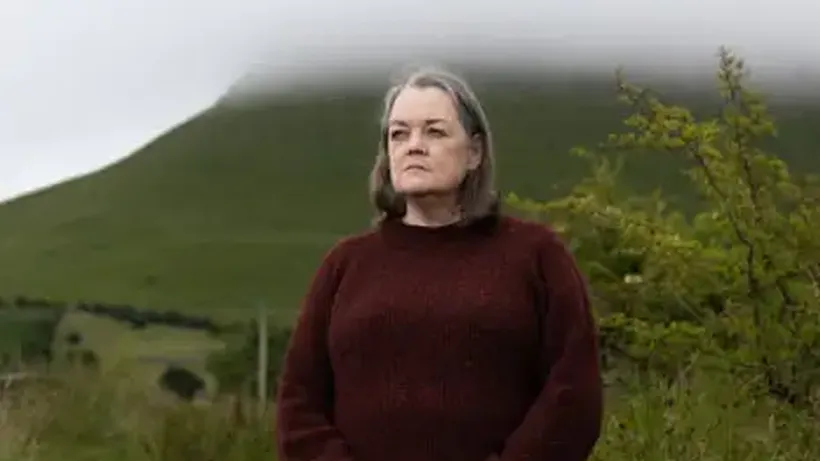
Louise Kennedy’s life has hardly wanted for dramatic events, but the recent past has been spectacularly busy, even by her standards. You wouldn’t know it to look at her, as we chat in the sitting room of the house in Sligo that she shares with her husband, son and daughter, but this is the home that she once thought would be repossessed. The couple bought it “for stupid money” in 2007, when they also opened a restaurant, initially so successful that the only way seemed to be up. The following year, financial mayhem descended on Ireland, their customers ebbed away, and the Celtic Tiger years morphed into a country racked with job losses, bankruptcies, apparently endless debt. “I didn’t think I’d ever be able to keep the house,” she says, glancing around an elegant room dotted with beautiful objects and plants, but nonetheless relaxed and comfortable. “I’d say we only got out of negative equity about a month ago. There are probably arguments for moving now, but I’m so proud that we managed to hold on to it, I’m not going anywhere. I’m going to be carried out of here in a box.”
Kennedy had been a chef for 30 years, working all over the place from Dublin to London and, for two years, Beirut, before ending up in Sligo, on Ireland’s west coast, not far from the border with her native Northern Ireland. Crucially, she had never given a thought to writing, not since a teacher had admired a poem she wrote when she was seven. Now, she is about to publish her second novel, Stations, which follows a collection of short stories, The End of the World Is a Cul-de-Sac, and her debut, Trespasses, which was shortlisted for the 2023 Women’s prize for fiction and won other prizes in Ireland and the UK in 2022 and 2023. Last year, Trespasses gained further acclaim when it was adapted for Channel 4 in a production starring Gillian Anderson as the mother of Cushla, the young Catholic teacher who falls in love with Michael, an older, married Protestant lawyer, in 1970s Belfast.
Trespasses fired readers’ imaginations because it gave an already complex love story a terrifying, high-stakes backdrop; Michael and Cushla’s relationship wasn’t simply clandestine because it was extramarital, but because they came from communities pitted against one another in an occupied country. And to recreate the detail, texture and jeopardy of Belfast at the time, Kennedy had to look no further than her own upbringing.
double quotation markIt was a complicated location shoot because a lot of the place was wrecked
She relates it so vividly and, at times, so humorously, that you have to remind yourself how intensely difficult it must have been. Kennedy’s Catholic family ran pubs in Belfast. One day, her grandmother was on her way to bank the takings when a bomb exploded in a building she was walking past and a chunk of glass pierced her jugular vein. “Some off-duty British soldier, a young fella who was down the town, held her neck together to stop her from bleeding to death until the ambulance came,” Kennedy recalls, before adding that her grandmother’s life was saved by the fur coat she’d been wearing. Throughout the ordeal, she wouldn’t let go of the handbag full of money, nor stop insisting she had to go and fetch her daughter from school.
“There was a lot of scarring on her face because she’d been cut by glass, but already, even in 71, the plastic surgeons in the north were just brilliant at patching people up. She just had very fine lines where the scarring was. She was really lucky.” What about psychologically? “She was a complete walking trauma case. She never talked about that. She wouldn’t even have known the word trauma. But if there was a loud noise, she’d go to pieces.”
double quotation markIn Northern Ireland, you just had to go on about your business, or you’d be freaking out left, right and centre
Meanwhile, Kennedy’s father had experienced intimidation at work, in a factory in East Belfast where he was the only Catholic. He had been followed home, and one of their Catholic neighbours had been killed in a loyalist “romper room” – essentially, an interrogation and murder site, the slang taken from a children’s TV programme. Now, her father was training to become an accountant through evening correspondence courses, simultaneously studying and minding the children while his wife went to work in the pub. One night, Kennedy’s mother, grandmother, two uncles and a policeman found themselves standing in a tunnel opposite the building when it was blown up, an attack that found its way into Trespasses. “It was a crazy thing to happen. And I think that that was the thing about the north: you know it’s not normal, you know it’s mental, but yet it is normal because this is how you have to live. You just have to go on about your business, because otherwise you’re going to be freaking out left, right, and centre. ”
Kennedy’s skill at conjuring the past without succumbing to the shorthand of nostalgia was one of the qualities that made for the success of the adaptation of Trespasses, which was written by Ailbhe Keogan, who also worked on Bad Sisters. “Ailbhe is not from the north, she’s from Kerry, and she was very open to me. I wanted the dialogue to be authentic to the north, but not just to the north. It also had to sound like 1975, and that’s quite easy for me to remember: the voice in my head is of a child in the north of Ireland in the 70s. And people don’t speak the same now as they did then. The place is really different. It was quite a complicated location shoot for that reason, because a lot of the place was wrecked and a lot of rebuilding has been done since that. It was pretty tricky to try and find a bar that hasn’t changed at all. The book is set in Holywood, County Down, where I grew up, but Holywood doesn’t look like it did in the 70s, so it was filmed in Portaferry, a village in County Down.”
In 1979, life changed again. Kennedy was 12, and in her first year at grammar school, when her parents decided they’d had enough and uprooted the family to Naas, then a small town not far south of Dublin. She hated it. “From my point of view, it was really crap.” She lost her pals, it took two years to get the phone connected, and even worse, there was only one television station, “so all of my cultural references had been wiped out”. Six weeks later, they went back to Belfast for a visit, and Kennedy was shocked to find how strange a friend’s accent sounded to her. “I just thought ‘Oh my God! I don’t belong anywhere.’ I didn’t belong to either place, and I still feel that now. When you leave a place, it goes on about its business, but for me it’s frozen in time.”
Back then, though, she didn’t have that perspective. “I was an atrocious adolescent. I was really angry that we’d had to leave and move to a place where there was one TV channel.” And it’s this dislocation that she’s mined for her new novel, Stations, in which two misfit teenage protagonists, Róisín and Red, cleave together to create some version of belonging. But as the story progresses from the early 1980s to this century, moving from Ireland to London, it becomes apparent that only one of them will thrive.
It’s a portrait not only of teenage alienation, displacement and small-town Ireland, but of one of the waves of Irish emigration that have characterised its history. Remembering her own time in London, Kennedy says that you could walk into a pub on Sunday mornings in the 1980s and 90s and feel like you were at mass. And you could also feel that you were in flight: “We left because there wasn’t work, but we also left because it was a closed, judgmental, shithole theocracy that we were living in, and we wanted to get the hell away.” It’s that historical precision that has led Anne Enright to say of Stations that “it holds a national sorrow”, describing it as a “work of mourning and reclamation”.
And in Róisín, Kennedy gave herself permission to write a “pain in the arse” character, unpopular, temperamental, self-centred, in contrast to Cushla whom, she says, readers found so likable. “I ran into a friend of mine recently who was in school with me. She was asking what the book is about and I said a character who moved from the north, and everybody in school hates her. She was like, is it a memoir?”
Back to that wild pivot from cooking to writing. How did all this happen? Put simply, Kennedy was still trying to keep her ailing restaurant on its legs back in 2014 when she found herself ambushed into going along to a new creative writing group set up by the writer Una Mannion. “Why would I be doing that?” she asked the friend doing the persuading, visual artist Niamh Mac Cabe, whereupon Mac Cabe just turned up and plonked her in the car. “I thought it was the most hilarious thing I’d ever heard in my life,” Kennedy remembers. But at that first meeting of eight or so people, Kennedy found herself committing to writing a piece over the next few weeks. “From the minute that I started trying to write this mad little short story – I didn’t even know what a short story was really – I just thought: I don’t really care what happens as long as I can find a way to keep doing this.”
That story, which eventually found its way on to national radio, drew on a family memory, and told of a young girl in the 1920s who gets into a world of trouble when she writes Rudolph Valentino’s name in the list of that month’s deaths at church. When she read it to the group, “I fully expected everybody just to laugh or to very politely move on from having to talk about my crap story, but they were wildly enthusiastic. So I thought, ‘OK, I’m going to try to write another one.’”
Partly, she was enjoying the distraction. At work, Kennedy and her husband were constantly firefighting to stave off creditors and make sure staff got paid. “We were skint. Everybody was, and I suppose the thing is that if the whole country is like that, it means that the people who in the past you might have been able to go and borrow a couple of bob from didn’t have any. They were all up the shit as well.” When the restaurant finally closed, a few months after she had joined the writing group, “I just thought, I don’t care. I could sit and fart around trying to write something for two or three hours and I wouldn’t even have thought about the business.”
After that seismic change, her writing life began to blossom; she accumulated short stories, did an MA and then started a PhD at Queens University in Belfast, where she was supervised by the writer Garrett Carr, and began to publish in magazines. She acquired an agent, Eleanor Birne, who was building a list of Irish writers, and who told her that her work might be more attractive to British publishers if they thought a novel was coming. “I had lied to her and said, ‘Oh yeah, I’m kind of working on a novel’, but I wasn’t really.” She told Carr the same. But in fact, the idea for Trespasses was beginning to brew.
And then, another curve ball arrived, in the form of a diagnosis of melanoma: a mole on her shoulder blade had mutated into cancer, and subsequently, the cancer had spread. First, there was the prospect of surgery and, later, immunotherapy. She didn’t, she says, want to be thinking about cancer all the time, but she knew she wouldn’t be working as she had been. “So I just rigged myself up a sling. I sat here, off my tits on really strong painkillers for a few days and watched all three series of Call My Agent. But I couldn’t really do anything, so I thought, OK, the only thing I can do is sit at the kitchen table and try to write 1,000 words a day of something that might be a novel, and see what happens. So by the time I went back to work, I had 64,000 words of something. It wasn’t really a novel. It was a pile of shite. But when I did actually go back to it, there was something on the page to fix.”
Kennedy subsequently endured various complications and resurgences of her original cancer, including damage to her pituitary gland that caused sudden menopause and severe endocrine problems. She has spent several years tailoring her life around treatment – during our conversation, an alarm reminds her to take one of her many daily pills – but she’s on far more of an even keel nowadays. I ask her whether the next book will follow a chronological pattern and anchor itself in the 1990s; the answer is yes, and she’s working on it.
Although she says she prefers the doing to the being when it comes to literary life – in other words, writing rather than talking about it – she’s established herself enough to rule out a return to the kitchen. At least, not professionally: before I leave, she ushers me to the table and produces, with zero fanfare, a homemade quiche, homemade bread, homemade paté and, finally, a vast homemade raspberry and lemon curd cake. Every mouthful is delicious. You can entirely imagine that, had a global financial crisis not wrecked her career as a restaurateur, she would still have been cooking up a storm: good news for diners, but a major blow to readers.
Stations by Louise Kennedy is published by Bloomsbury. To support the Guardian, order your copy at guardianbookshop.com. Delivery charges may apply.