‘What We Have Is Unique’: The Indian Craftsmanship Behind Global Luxury Fashion
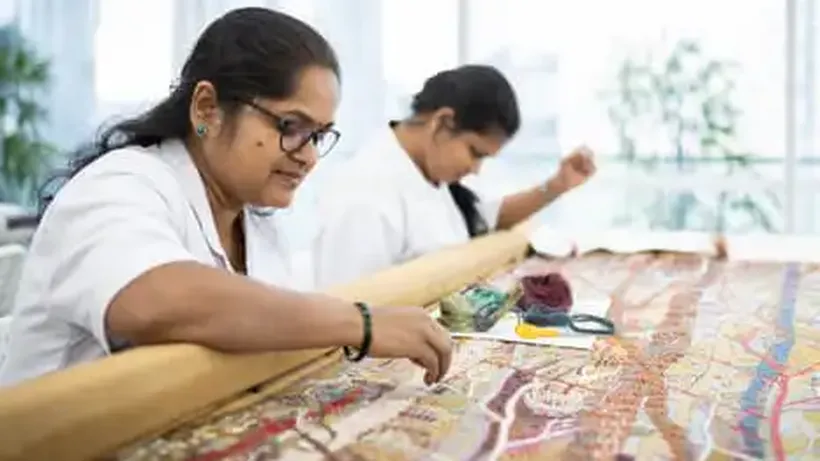
The zardozi embroidery on a Dior dress, the T-strap leather sandals at a Prada show, the mirror-work technique used on a Fendi bag – for decades, the skill of Indian artisans has been an invisible force behind some of the world’s most coveted fashion.
Now, that work is beginning to claim its own place in the spotlight, and the Mumbai-based textile and embroidery atelier Chanakya International is at the forefront.
Chanakya marked its 40th anniversary this month, celebrating with three exhibitions that trace its journey from an embroidery powerhouse to a present-day craft and cultural institution. The person steering it is 49-year-old Karishma Swali, whose father set up the group’s operations in the 1980s.
“What we have as a country is unique,” she tells me of India’s rich textile and craft heritage. “It’s unparalleled in many ways, and it’s the only place where we continue to practise it.” During the Renaissance, she says,France and Italy had established and varied traditions. “But what we have in India today is [what] other parts of the world have lost.”
Chanakya has a network of 1,400 artisans, and says that some are 13th-generation craftspeople, skilled in hundreds of embroidery traditions and supplying almost every luxury label you can imagine. Among the techniques they have revived is the Mughal-era silver filigree lace, or chaand jaal, reintroduced in a lighter form that has since become a regular feature in couture collections.
In 2023, Dior held a show at Mumbai’s Gateway of India, showcasing its partnership with Chanakya, in a high-profile acknowledgment of Indian craftsmanship. The runway saw sari-inspired skirts, vibrant madras-checks sets and Nehru-collar jackets.
These collaborations are supported by expert craft knowledge passed down and refined over generations, and they need institutional support to survive. The Kalhath Institute, a craft-preservation centre in Lucknow, runs residencies that pair artists from across the world with local artisans.
Kalhath’s co-founder Mohammed Amine Dadda tells me that Indian craftsmanship’s defining quality is “intelligence of the hand” – a sensitive, slow and cumulative process underpinned by patience and dexterity. “Without this technical mastery, and the considerable time required to create the most demanding pieces, haute couture and contemporary luxury simply could not bring their most ambitious creative visions to life.”
This mastery is not limited to textiles. When it comes to jewellery, global luxury brands have long sought Jaipur-based the Gem Palace, established in 1852 by the Kasliwal family, who still run it today. Samarth Kasliwal, 33, says part of the appeal lies in the visual language of Indian artistry itself. “There is something about Indian artistry that is inspired by nature,” he tells me, pointing to the recurring use of floral patterns and animals across Indian art and design. These motifs are universal, and travel across the lines of culture and language.
One recent collaboration Kasliwal is particularly proud of is a collection for Dior featuring green onyx and rock crystals, with engravings of birds, animals and flowers. The combination, he says, is reminiscent of traditional Indian jewellery, while drawing on techniques that remain central to the atelier’s work today.
With increased visibility, the question of credit and appropriation has become harder to ignore. Last week, a Ralph Lauren gown from the designer’s spring 2027 collection attracted criticism after many Indians pointed out that the embroidery the brand described as “embellishments” looked a lot like Indian zardozi, but without any accompanying credit. (Ralph Lauren did not respond to my request for comment.)
Then, Fendi came under fire when people noticed that a baguette bag from its autumn/winter collection featured mirrorwork often seen in Gujarati crafts. In April, Fendi credited Chanakya artisans in a social media video showcasing the same embroidery. But the product description on its site failed to mention any Indian inspiration, and its final label read “Made in Italy”.
After I asked Fendi about the discrepancy, the brand cited its “creative partnership” with Chanakya of more than three decades, saying it “remains committed to supporting and recognizing India’s rich craft heritage”. The website descriptor now reads: “Made in Italy and India with Chanakya”.
A recent Financial Timesreport noted that under EU rules, garments embroidered in India can still end up with a European label – so long as the final construction and finishing take place in Europe.
Last year, Prada was accused of appropriating Indian culture with Kolhapuri-inspired sandals, a controversy that showed us these debates around recognition can sometimes produce a more structural response. “We acknowledge the sandals … are inspired by traditional Indian handcrafted footwear, with a centuries-old heritage,” Lorenzo Bertelli, the corporate social responsibility chief at the Italian fashion house, had written in a letter to the Maharashtra chamber of commerce at the time.
Prada subsequently partnered with state-backed organisations in Maharashtra and Karnataka to produce a limited-edition collection, Made in India, and committed to a three-year training programme for artisans specialising in the craft.
Might these collaborations, controversies and corrections represent a shift in India’s place in the fashion industry? Anthropologist Phyllida Jay, author of Inspired by India: How India Transformed Global Design, appears to think so, placing the debate in a longer arc. “The stories of the ateliers producing highly skilled Indian craft in the elevated realm of European luxury and high fashion is part of a broader paradigm shift,” she writes, “where over 70 years after the end of colonial rule, India is being looked at in a different way on the world stage.” It is, in a way, a reversal, moving from a colonial history of extraction toward one in which Indians themselves get a voice in how their craft is represented.
Swali is ensuring this visibility also lives on through the Chanakya School of Craft, which she set up in 2016. Its 18-month programme provides free embroidery training and a travel honorarium to dozens of women, some of whom have gone on to work at the main atelier. Others have set up their own independent studios.
I had a chance to visit the space – inside a high-rise in Lower Parel, where those as young as 18 learn intricate needlework alongside grandmothers in their 60s. “Craft in India has never been institutionalised,” Swali says of the ethos behind the initiative. “It’s intergenerational,” she says, adding that women have often been excluded.
India’s culture of craft has always been precious. Growing up, I loved having the choice to affordably create any type of clothing. At one point, I had a small army of tailors, each with a different specialisation, whom I’d go to for different needs. I’d buy ajrakh and mashru silks from Dastkar or Nalli, and hand it to the right Masterji to stitch, embroider and tweak to my size. So, to me, Indian craftsmanship is not just a part of luxury, but a luxury itself.
What Else We’re Reading About
Travel | Time Out just confirmed what everyone in Mumbai’s Bandra West knows: that it’s one of the coolest neighbourhoods in the world. The other Indian spot to make the cut is Delhi’s food and fashion centre, Humayunpur. The top spot went to Jongno 3-ga in Seoul – my second home!
Business | India will levy a 0.4% charge on merchants for UPI payments above Rs 2,000, starting on 15 October. The charges will not be applicable when the payment is made from one person to another. Ashneer Grover, co-founder and former CEO of fintech firm BharatPe slammed the move, describing it as “tax collection”.
Immigration | An investigation by Scroll’s Rokibuz Zaman has revealed a troubling pattern in West Bengal: since June, at least nine Muslim men and two children have been picked up by the police from their homes over allegations that they are Bangladeshi nationals – without being given a chance to prove their citizenship. Most were picked up and detained in midnight raids, the report said, and family members accused the police of not producing warrants.
Guest Shelf
A recommendation from someone with great taste
Fashion designer Payal Khandwala, whose spring-summer ’26 collection featured handwoven silks, cottons and brocades, recommends the perfect saree weave: “The delicate poetry of a Jamdani saree is definitely my favourite. A 2,000-year-old craft, typically woven in fine muslin and of Bengali origin, it’s somewhat an unsung hero. The weaving process itself is exceptionally intricate. Using a supplementary weft technique, thousands of markings are meticulously mapped on to the warp to recreate the pattern, interlaced by hand with a wooden shuttle and metallic needle to guide the motifs in silver and gold yarn, on fine mulberry silk and organza.”
Count It
A number worth knowing
13,138
Foreign investors have pulled out Rs 13,138 crore (£1.02bn)from Indian equities in the first half of September, wiping out about half of the net inflows recorded in August.
Vibe Check
The true measure of my love for my friends is in the number of memes I send them. One of the accounts I rely on is Bahaish Kapoor’s. The screenwriter-turned-meme evangelist pairs black-and-white Bollywood stills with contemporary gen Z sass, and lets incongruity do the rest. What makes an image meme-worthy? “I always look for people who are in a deep philosophical, romantic, dramatic action moment which I can repurpose to bring in a whole new meaning,” he tells me. “I try to mix and match and see what’s working.” His 340,000-plus followers include Sharon Stone and Hrithik Roshan.
“I just want to make people feel a little better,” says Kapoor, adding that he receives a lot of DMs from people about how his page helped them through a bad day. “People confessing that they are lighter because of this experience is all that I can hope for. I mean, that’s the endgame.”
Get In Touch
Do you have any thoughts or responses to this week’s newsletter? Is there anything you’d like us to cover in the future? Share your feedback by replying to this, or emailing us at [email protected] and we may include your response in a future issue.